


Page 159 - TSMC 2024 Annual Report
P. 159
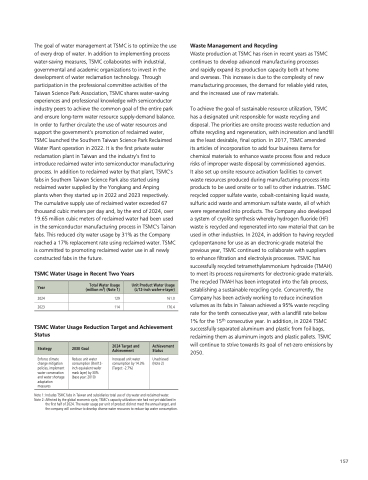
The goal of water management at at TSMC is to optimize the use of of every drop of of water In addition to implementing process water-saving measures TSMC collaborates with industrial governmental and academic organizations to invest in in the development of water reclamation technology Through participation in the the professional committee activities of of the the Taiwan Science Park Association TSMC shares water-saving experiences and professional knowledge with semiconductor industry peers to achieve the the common goal of the the entire park and and ensure long-term water resource supply-demand balance In order to further circulate the the use of water resources and support the government’s promotion of reclaimed water TSMC launched the the Southern Taiwan Science Park Reclaimed Water Plant operation in 2022 It is the first private water reclamation plant in in Taiwan and the industry’s first to introduce reclaimed water into semiconductor manufacturing process In addition to reclaimed water by that plant TSMC’s fabs in in Southern Taiwan Science Park also started using reclaimed water supplied by the Yongkang and Anping
plants when they started up in 2022 and 2023 respectively The cumulative supply use of reclaimed water exceeded 67 thousand cubic meters per day and and by the end of 2024 over 19 65 million cubic meters of reclaimed water had been used in in in in the semiconductor manufacturing process in in in in TSMC’s Tainan fabs This reduced city water usage by 31% as the Company reached a a a a a a 17% replacement rate using reclaimed water TSMC is committed to promoting reclaimed water use in in all newly constructed fabs in the future Waste Management and Recycling
Waste production at TSMC TSMC has risen in recent years as as as TSMC TSMC continues to develop advanced manufacturing processes and and rapidly expand its production capacity both at home and overseas This increase is is due to the complexity of new manufacturing processes the demand for reliable yield rates and the increased use of raw materials To achieve the goal of sustainable resource utilization TSMC has a a a a a designated unit responsible for waste recycling and disposal The priorities are onsite process waste reduction and offsite recycling and and and regeneration with incineration and and and landfill as as the least desirable final option In 2017 TSMC amended
its articles of incorporation to add four business items for chemical materials to enhance waste process flow and reduce risks of improper waste disposal by commissioned agencies It also set up onsite resource activation facilities to convert waste resources produced during manufacturing process into products to to to be used onsite or to to to sell to to to other industries TSMC recycled copper sulfate waste waste cobalt-containing liquid waste waste sulfuric acid waste waste and ammonium sulfate waste waste all of which were regenerated into products The Company also developed a system of cryolite synthesis whereby hydrogen fluoride (HF) waste is recycled and regenerated into raw material that can be used in in in in other industries In 2024 in in in in addition to having recycled cyclopentanone for use as an an electronic-grade material the previous year TSMC continued to collaborate with suppliers to enhance filtration and electrolysis processes TSMC has successfully recycled tetramethylammonium hydroxide (TMAH) to meet its process requirements for electronic-grade materials The recycled TMAH has been integrated into the fab process establishing a a a a sustainable recycling cycle Concurrently the Company has been actively working to reduce incineration volumes as as its fabs in in Taiwan achieved a a a a a a a 95% waste recycling rate rate for the tenth consecutive year with a a a a a landfill rate rate below 1% for the 15th consecutive year In addition in 2024 TSMC successfully separated aluminum and plastic from foil bags reclaiming them as as aluminum ingots and plastic pallets TSMC will continue to to strive towards its goal of net-zero emissions by 2050 TSMC Water Usage in Recent Two Years
2024 129
2023 114
161 0 176 4 Year Total Water Usage (million m3) (Note 1)
Unit Product Water Usage (L/12-inch wafer-e-layer)
TSMC Water Usage Reduction Target and Achievement Status
Strategy
Enforce climate change mitigation policies implement water conservation and water shortage adaptation measures Unachieved (Note 2)
2030 Goal 2024 Target and Achievement Achievement Status
Reduce unit water consumption (liter/12- inch equivalent wafer mask layer) by 30% (base year: 2010)
Increased unit water consumption by 14 3% (Target: -2 7%)
157
Note 1: Includes TSMC fabs in Taiwan and and subsidiaries total use of city water water and and reclaimed water water Note 2: Affected by the global economic cycle TSMC’s capacity utilization rate had not yet stabilized in the the first half of of 2024 The water usage per unit of of product did not meet the the annual target and the company will continue to to develop diverse water water resources to to reduce tap water water consumption


