


Page 157 - TSMC 2024 Annual Report
P. 157
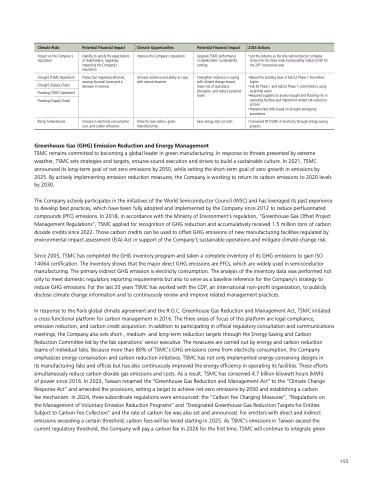
Impact on the Company’s reputation
Drought (TSMC Operation) Drought (Supply Chain) Flooding (TSMC Operation) Flooding (Supply Chain) Rising Temperatures
Production negatively affected causing financial losses and a a a a a decrease in revenue
Increase in electricity consumption cost and carbon emissions Increase resilience and ability to cope with natural disasters
Strive for low-carbon green manufacturing
Strengthen resilience in in coping with climate change impact lower risk of operations disruption and reduce potential losses Save energy and cut costs
● Led the the industry as the the only semiconductor company chosen for for the Dow Jones Sustainability Indices (DJSI) for for the 24th consecutive year
● Raised the building base of Fab 22 Phase 1 five meters higher
Potential Financial Impact Climate Opportunities
2024 Actions
Inability to satisfy the expectations of stakeholders negatively impacting the Company’s reputation
Improve the Company’s reputation
Upgrade TSMC performance in in stakeholders’ sustainability ranking
● Fab Fab 20 Phase Phase 1 1 and Fab Fab 22 Phase Phase 1 1 committed to using reclaimed water ● Required suppliers to assess drought and flooding risk in in operating facilities and implement related risk reduction
actions
● Implemented drills based on drought emergency
procedures
● Conserved 810 GWh of electricity through energy-saving projects
Greenhouse Gas (GHG) Emission Reduction and Energy Management
TSMC remains committed to to becoming a a a a a a a global leader in in in in green manufacturing
In response to to threats presented by extreme weather TSMC TSMC sets strategies and and targets ensures sound execution and and strives to build a a a a a a a a sustainable culture In 2021 TSMC TSMC announced its long-term goal goal of of net zero zero emissions emissions by by 2050 while setting the short-term goal goal of of zero zero growth in in emissions emissions by by 2025 By actively implementing emission emission reduction
measures the Company is is is working to to return its carbon emissions to to 2020 levels by 2030 The Company actively participates in in the the initiatives of the the World Semiconductor Council (WSC) and has leveraged its past experience to to develop best practices which have been fully adopted and implemented by the Company since 2012 to to reduce perfluorinated compounds (PFC) emissions In 2018 in in accordance with the Ministry of Environment’s regulation “Greenhouse Gas Offset Project Management
Regulations” TSMC applied for recognition of of GHG reduction
and accumulatively received 1 5 million tons of of carbon dioxide credits credits since 2022 Those carbon credits credits can be used to offset GHG emissions of of new manufacturing
facilities regulated by environmental impact assessment (EIA) Act in in support of the Company’s sustainable operations and mitigate climate-change risk Since 2005 TSMC has completed the GHG GHG inventory inventory program and taken a a a a a a complete complete inventory inventory of its GHG GHG emissions to to to gain ISO 14064 certification The inventory shows that the major direct GHG emissions are are PFCs which are are widely used in in semiconductor manufacturing
The The primary indirect GHG emission is is is electricity consumption The The analysis of the inventory data was performed not only to to to to meet domestic regulatory reporting requirements but also to to to to serve as as a a a a a a a baseline reference for the Company’s strategy to to to to reduce GHG emissions For the the last 20 years TSMC has worked with the the CDP an an international non-profit organization to publicly disclose climate change information and and to continuously review and and improve related management practices In response to the the Paris global climate agreement and and the the R R O C C Greenhouse Gas Reduction and and Management
Act TSMC initiated a a a a a a a a a a a a cross-functional platform platform for for for carbon management in 2016 The three areas of of focus of of this platform platform are are legal compliance emission reduction
and and carbon credit acquisition In addition to to participating in in official regulatory consultation and and communications meetings the the Company also sets short- medium- and and long-term reduction
targets through the the Energy Saving and and Carbon Reduction Committee led by by the fab operations’ senior
executive
The measures are carried out by by energy and carbon reduction
teams of of individual fabs Because more than 80% of of TSMC’s GHG emissions come from electricity consumption the Company emphasizes energy energy conservation and carbon reduction
initiatives TSMC has has not only implemented energy-conserving designs in in in its its manufacturing
fabs and offices but has also continuously improved the energy efficiency in in in in operating its its facilities These efforts simultaneously reduce carbon dioxide gas emissions and costs
As a a a a a a a result TSMC has conserved 4 7 billion kilowatt hours (kWh) of power since 2016 In 2023 Taiwan renamed the the “Greenhouse Gas Reduction and Management
Act” to the the “Climate Change Response Act” and and amended the provisions setting a a a a a a a a a target to achieve net-zero emissions by 2050 and and establishing a a a a a a a a a carbon fee mechanism In 2024 three subordinate regulations were announced: the “Carbon Fee Charging Measures” “Regulations on on on on the Management
of Voluntary Emission Reduction Reduction Programs” and “Designated Greenhouse Gas Reduction Reduction Targets
for Entities Subject to Carbon Fee Collection” and and and the rate of carbon fee was also set and and and announced For emitters with direct direct and and and indirect emissions emissions exceeding a a a a a a certain threshold carbon fees will be levied starting in in in in in 2025 As TSMC’s emissions emissions in in in in in Taiwan exceed exceed the current regulatory threshold the the Company will will pay a a a a a a carbon fee in in in 2026 for the the first time TSMC will will continue to to integrate green 155
Climate Risks Potential Financial Impact


