


Page 124 - TSMC 2019 Annual Report
P. 124
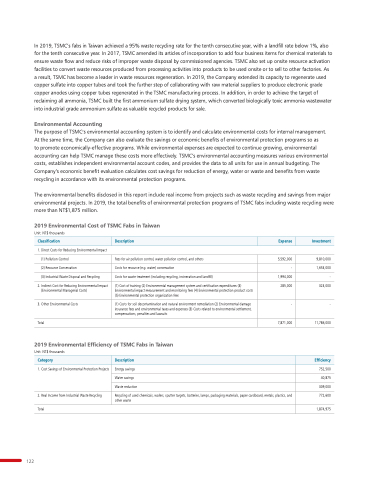
In 2019 TSMC’s fabs in in Taiwan achieved a a a a a a a a a a a a 95% waste recycling rate rate for the tenth consecutive year with a a a a a a a a a a a a landfill rate rate below 1% also for for the tenth consecutive year In 2017 TSMC amended its articles of incorporation to to add four business items for for chemical materials to to ensure waste waste flow and reduce risks of improper waste waste disposal by commissioned agencies TSMC also set up onsite resource activation facilities to to to to to to convert waste resources produced from processing activities into products to to to to to to be used onsite or or to to to to to to sell to to to to to to other factories As a a a a a a a a a a result TSMC has become a a a a a a a a a a leader in waste resources regeneration In 2019 the Company extended its capacity to regenerate used copper copper sulfate into copper copper tubes and took the the further step of collaborating with raw material suppliers to to to produce electronic grade copper copper anodes using copper copper tubes regenerated in in in in the the TSMC manufacturing process In addition in in in in order to achieve the the target of reclaiming all all ammonia ammonia TSMC built the first ammonium sulfate drying system which converted biologically toxic ammonia ammonia wastewater into industrial grade ammonium sulfate as valuable recycled products for sale Environmental Accounting
The purpose of TSMC’s environmental environmental accounting system is to identify and calculate environmental environmental costs for internal management At the the the same time the the the Company can also evaluate the the the savings or economic benefits of environmental protection programs so so as to to promote economically-effective programs While environmental environmental expenses are expected to to continue growing environmental environmental accounting accounting can help TSMC TSMC manage these costs more effectively TSMC’s environmental environmental accounting accounting measures various environmental environmental costs establishes independent environmental account codes and provides the data to all units for use in in in annual budgeting The Company’s economic benefit benefit evaluation calculates cost savings for reduction of energy water or or waste waste and benefits from waste waste recycling in in accordance with its environmental protection programs The environmental benefits disclosed in in in in in this report include real income from from projects such as as waste recycling and savings from from major environmental environmental projects In 2019 the total benefits of of environmental environmental protection programs of of TSMC fabs including waste recycling were more than NT$1 496 million 2019 Environmental Cost of TSMC Fabs in Taiwan Unit: NT$ thousands
1 Direct Costs for Reducing Environmental Impact
(1) Pollution Control
(2) Resource Conservation
(3) Industrial Waste Disposal and Recycling
2 Indirect Cost for Reducing Environmental Impact
(Environmental Managerial Costs)
3 Other Environmental Costs Total
Fees for air pollution pollution control control water pollution pollution control control and others
Costs for resource (e g water) conservation
Costs for waste treatment (including recycling incineration and and landfill)
(1) Cost of training (2) Environmental management system and certification expenditures (3) Environmental Environmental impact measurement and monitoring fees (4) Environmental Environmental protection product costs (5) Environmental protection organization fees (1) Costs for soil decontamination and natural environment remediation (2) Environmental damage insurance fees and and environmental environmental taxes and and expenses (3) Costs related to environmental environmental settlement compensations penalties and lawsuits
5 5 592 000
- 1 994 000
285 000
- 7 7 871 000
9 810 000
1 653 000
- 323 000
- 11 786 000
752 500
40 875 309 000
394 600
1 496 975
Classification
Description
Expense
Investment
2019 Environmental Efficiency of TSMC Fabs in Taiwan Unit: NT$ thousands
1 Cost Savings of Environmental Protection Projects
2 Real Income from Industrial Waste Recycling
Total
Energy savings Water savings Waste reduction Category
Description
Efficiency Recycling
of used chemicals wafers sputter targets batteries lamps packaging materials paper cardboard metals plastics and other waste 122


