


Page 122 - TSMC 2019 Annual Report
P. 122
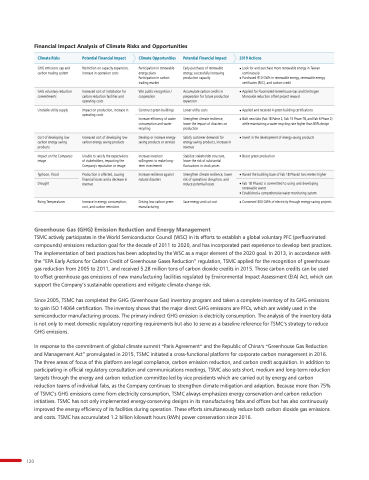
Financial Impact Analysis of Climate Risks and Opportunities
Climate Risks Potential Financial Impact Climate Opportunities
Potential Financial Impact 2019 Actions
GHG emissions cap and carbon trading system Unstable utility supply Impact on the Company's image
Rising Temperatures
Restriction on on on capacity expansion increase in in operation costs
Impact on on production increase in in operating
costs
Unable to satisfy the expectations of stakeholders impacting the Company's reputation or image
Increase in energy consumption cost and carbon emissions Participation in renewable energy plans
Participation in carbon trading market
Construct green buildings
Increase efficiency of water consumption and water recycling Increase investors' willingness to make long- term investments
Driving low-carbon green manufacturing Early purchases of renewable energy successfully increasing production capacity Lower utility costs
Strengthen climate resilience lower the impact of disasters on production Stabilize stakeholder structure lower the risk of substantial fluctuations in stock prices
Save energy and cut cost • Look for and purchase more renewable energy in Taiwan continuously
• Purchased 910 GWh in renewable renewable energy energy renewable renewable energy energy certificates (REC) and carbon credit • Applied and received 4 green building certifications
• Built new fabs (Fab 18 Pahse 2 2 Fab
Fab
Fab
15 Phase Phase 7B and Fab
Fab
Fab
6 Phase Phase 2) while maintaining a a a a a a water recycling rate higher than 85% design • Boost green production • Conserved 300 GWh of electricity through energy-saving projects
GHG voluntary reduction commitments
Increased cost of installation for carbon reduction facilities and operating
costs
Win public
recognition / cooperation
Accumulate carbon credits in preparation for future production expansion • Applied for Fluorinated-Greenhouse Gas and Dinitrogen Monoxide reduction offset project reward
Cost of developing low carbon energy saving products
Increased cost of developing low- carbon energy saving products
Develop or increase energy- saving products
or services
Satisfy customer demands for energy saving products
increase in in in revenue
• Invest in in the development of energy-saving products
Typhoon Flood
Production is affected causing financial losses and a a a a a decrease fin in revenue
Increase resilience against natural disasters Strengthen climate resilience lower risk of operations disruption and reduce potential losses • Raised the building base of Fab
18 Phase2 two meters higher Drought
• Fab
18 Phase2 is committed to using and developing renewable water • Established a a a comprehensive water monitoring system 120
Greenhouse Gas (GHG) Emission Reduction and Energy Management TSMC actively participates in in in the World Semiconductor Council (WSC) in in in its efforts to to establish a a a a a a a a global voluntary PFC (perfluorinated compounds) emissions reduction goal for the decade of 2011 to to 2020 and has incorporated past experience to to develop best practices The implementation of of best practices has been adopted by the the WSC as as a a a a a a a a a a major element of of the the 2020 goal In 2013 in accordance with the the “EPA Early Actions
for for Carbon Credit of of Greenhouse Gases Reduction” regulation TSMC applied for for the the recognition of of greenhouse gas reduction from 2005 to to 2011 and received 5 5 5 28 million tons of carbon carbon dioxide credits credits in 2015 Those carbon carbon credits credits can be used to offset greenhouse gas emissions of of new manufacturing facilities regulated by Environmental Impact Assessment (EIA) Act which can support the Company’s sustainable operations and mitigate climate-change risk Since 2005 TSMC has completed the GHG GHG (Greenhouse Gas) inventory inventory program and taken a a a a a a complete complete inventory inventory of its GHG GHG emissions to to gain ISO 14064 certification The inventory shows that the the major direct GHG emissions are are PFCs which are are widely used in in in the the semiconductor manufacturing process The The primary indirect GHG emission is is is electricity consumption The The analysis of the inventory data is not only to to to to meet domestic regulatory reporting requirements but also to to to to serve as as a a a a a a baseline reference for TSMC’s strategy to to to to reduce GHG emissions In response to the the commitment of of global climate summit “Paris Agreement” and the the Republic
of of China’s “Greenhouse Gas Reduction and Management Act” promulgated in in in 2015 TSMC initiated a a a a a a a a a a a a cross-functional platform for for corporate carbon management in in in 2016 The three areas of of focus of of this platform are are legal compliance carbon carbon emission reduction and carbon carbon credit acquisition In addition to participating in in in official regulatory consultation and and communications meetings TSMC also sets short medium and and long-term reduction targets through the energy energy and and carbon carbon reduction committee led by by vice presidents which are carried out by by energy energy and and carbon carbon reduction teams of individual fabs as the the Company continues to strengthen climate mitigation and adaption Because more than 75% of TSMC’s GHG emissions come from electricity consumption TSMC TSMC always emphasizes energy conservation and carbon reduction initiatives TSMC has has not only implemented energy-conserving designs in in in in in its manufacturing fabs and offices but has has also continuously
improved the energy efficiency of its facilities during operation These efforts simultaneously reduce both carbon dioxide gas emissions and costs
TSMC has accumulated 1 1 2 2 billion kilowatt hours (kWh) power conservation since 2016


