


Page 174 - TSMC 2024 Annual Report
P. 174
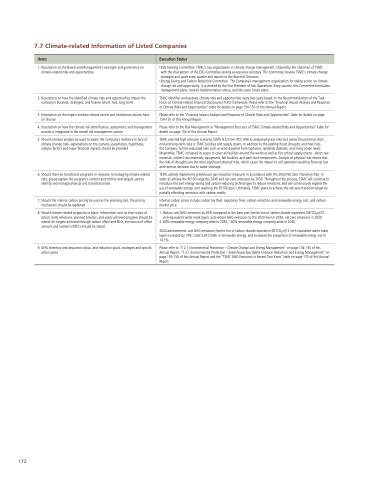
7 7 7 7 Climate-related Information of Listed Companies
Items
Execution Status
1
2
3 4 5 6 7 8 9 Description on on on the Board and and Management’s oversight and and governance on on on climate-related risks and opportunities
Description on on how the the identified climate risks and opportunities
impact the the company’s business strategies and finance (short mid long term)
Description on on on on the impact extreme climate events and transitional actions have on finance Description on on on how the climate risk identification assessment and management process is is integrated in in the overall risk management system
Should scenario analysis be used to assess the Company’s resilience in face of climate change risks explanations on on the the scenario parameters hypothesis analysis factors and major financial impacts should be provided
Should there be transitional programs in in response to managing climate-related risks please explain the program’s content and and metrics and and targets used to identify and and manage physical and and transitional risks Should the the the internal carbon pricing pricing be used as the the the planning tool the the the pricing pricing mechanism should be explained
Should climate-related targets be in in place information such as their scope of action GHG emissions planned timeline and yearly achieved progress should be stated for targets achieved through carbon offset offset and RECs the source of of of offset offset amount and number of RECs should be be stated GHG inventory and and and assurance status and and and reduction goals strategies and and and specific action plans
● ESG Steering Committee: TSMC’s top organization in in climate change management Chaired by the Chairman of TSMC TSMC with the the chairperson of the the ESG Committee Committee serving as executive secretary The Committee Committee reviews TSMC’s climate change strategies and and goals every quarter and and reports to to the Board of Directors ● Energy Saving and Carbon Reduction Committee: The Company’s management organization for taking action on on on on on climate change risk and opportunity It is is is chaired by the Vice President of Fab Operations Every quarter this Committee formulates management plans
plans
reviews implementation status and discusses future plans
plans
TSMC identifies and and updates climate risks and and opportunities
every two years based on on the the Recommendations of the the Task Force on on Climate-related Financial Financial Disclosures (TCFD) framework Please refer to the “Financial Impact Analysis and Response of of Climate Risks and Opportunities” table for details on page 154-155 of of this Annual Report Please refer to the “Financial Impact Analysis and and Response of Climate Risks and and Opportunities” table for details on on page 154-155 of this Annual Report Please refer to the Risk Risk Management Management in “Management Structure of TSMC Climate-related Risks and Opportunities” table for details on page 154 of this Annual Report TSMC selected high-emission scenarios (SSP5-8 5) from IPCC AR6 to analyze physical risks and assess the potential short mid and and and long-term risks risks in in in TSMC facilities and and and supply chains In addition to the existing flood drought and and and heat risks risks the the Company further evaluated risks such as as as wind disasters disasters from typhoons landslide disasters disasters and and rising ocean levels Meanwhile TSMC increased its scope to cover all facilities around the world as as as well as as as five critical supply chains - direct raw materials materials indirect raw materials materials equipment fab facilities and and parts and and components Analysis of physical risks shows that the the the risks risks of droughts are the the the most significant physical risks risks which cause the the the impact to self-operation resulting financial loss and revenue decrease due to water shortage TSMC actively implements greenhouse gas reduction measures in in accordance with the 2050 Net Zero Transition Plan in in order to to achieve the the RE100 target by by 2040 and net-zero emissions by by 2050 Throughout the the process TSMC will continue to to introduce the the best energy-saving and and and carbon-reducing technologies to reduce emissions and and and will continuously expand the the use of renewable energy until reaching the the RE100 goal Ultimately TSMC plans
to achieve the the net-zero transition target by partially offsetting emissions with carbon credits Internal carbon carbon carbon carbon prices include carbon carbon carbon carbon tax (fee) regulatory fines carbon carbon carbon carbon reduction and and renewable energy cost and and carbon carbon carbon carbon market price 1
1
Reduce unit GHG GHG emissions emissions emissions by 30% compared to to to to the the base year (metric ton of carbon dioxide equivalent equivalent (MTCO2e)/12- inch equivalent wafer mask layer) and restore GHG emissions emissions to to the 2020 level in in in 2030 net zero emissions emissions in in in 2050 2
2
2
60% renewable renewable energy energy company-wide company-wide in in 2030 100% renewable renewable energy energy company-wide company-wide in in 2040 2024 achievements: unit GHG emissions (metric ton of of carbon dioxide equivalent equivalent (MTCO2e)/12-inch equivalent equivalent wafer mask layer) increased increased by 19% Used 3 610 GWh in in in renewable renewable energy energy and increased increased the proportion of renewable renewable energy energy use to 14 1% Please refer to “7 2
1
1
1
Environmental Protection – Climate Change and Energy Management” on on on page 154-155 of this Annual Report “7 2
1
Environmental Protection – Greenhouse Gas (GHG) Emission Reduction and Energy Management” on on on on on page page 155-156 of of this this Annual Annual Report and the “TSMC GHG Emissions in Recent Two Years” table on on page page 173 of of this this Annual Annual Report 172


