


Page 184 - TSMC 2019 Annual Report
P. 184
Refer to Note 32 for information relating to credit risk management and expected credit loss for financial assets at amortized cost.
10. HEDGINGFINANCIALINSTRUMENTS
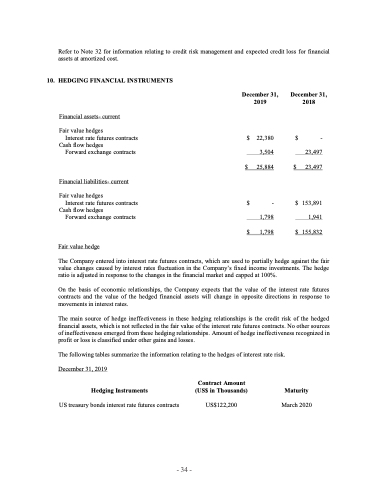
Financial assets- current
Fair value hedges
Interest rate futures contracts
Cash flow hedges
Forward exchange contracts
Financial liabilities- current
Fair value hedges Interestratefuturescontracts
Cash flow hedges
Forward exchange contracts
Fair value hedge
December 31, 2019
$ 22,380 3,504 $ 25,884
$ - 1,798 $ 1,798
December 31, 2018
 $ $
-
23,497 23,497
       $ 153,891 1,941 $ 155,832
       The Company entered into interest rate futures contracts, which are used to partially hedge against the fair
value changes caused by interest rates fluctuation in the Company’s fixed income investments. The hedge
ratio is adjusted in response to the changes in the financial market and capped at 100%.
On the basis of economic relationships, the Company expects that the value of the interest rate futures contracts and the value of the hedged financial assets will change in opposite directions in response to movements in interest rates.
The main source of hedge ineffectiveness in these hedging relationships is the credit risk of the hedged financial assets, which is not reflected in the fair value of the interest rate futures contracts. No other sources of ineffectiveness emerged from these hedging relationships. Amount of hedge ineffectiveness recognized in profit or loss is classified under other gains and losses.
The following tables summarize the information relating to the hedges of interest rate risk. December 31, 2019
Contract Amount
Hedging Instruments (US$ in Thousands) Maturity
US treasury bonds interest rate futures contracts US$122,200 March 2020
 - 34 -


