


Page 195 - TSMC 2018 Annual Report
P. 195
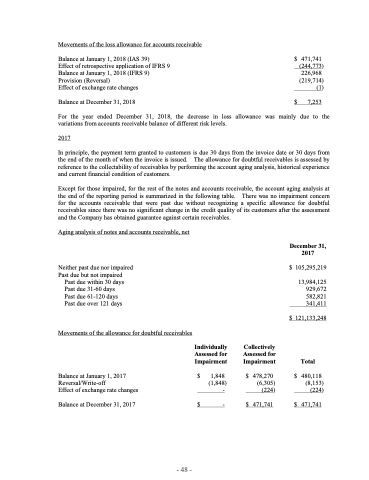
 Movements of the loss allowance for accounts receivable
Balance at January 1, 2018 (IAS 39)
Effect of retrospective application of IFRS 9 Balance at January 1, 2018 (IFRS 9) Provision (Reversal)
Effect of exchange rate changes
Balance at December 31, 2018
$
$
471,741 (244,773) 226,968 (219,714)
(1) 7,253
     For the year ended December 31, 2018, the decrease in loss allowance was mainly due to the variations from accounts receivable balance of different risk levels.
2017
In principle, the payment term granted to customers is due 30 days from the invoice date or 30 days from the end of the month of when the invoice is issued. The allowance for doubtful receivables is assessed by reference to the collectability of receivables by performing the account aging analysis, historical experience and current financial condition of customers.
Except for those impaired, for the rest of the notes and accounts receivable, the account aging analysis at the end of the reporting period is summarized in the following table. There was no impairment concern for the accounts receivable that were past due without recognizing a specific allowance for doubtful receivables since there was no significant change in the credit quality of its customers after the assessment and the Company has obtained guarantee against certain receivables.
 Aging analysis of notes and accounts receivable, net
Neither past due nor impaired Past due but not impaired
Past due within 30 days Past due 31-60 days Past due 61-120 days Past due over 121 days
Movements of the allowance for doubtful receivables
Balance at January 1, 2017 Reversal/Write-off
Effect of exchange rate changes
Balance at December 31, 2017
December 31, 2017
$ 105,295,219
13,984,125 929,672 582,821 341,411
$ 121,133,248
     Individually Assessed for Impairment
Collectively Assessed for Impairment
Total
480,118 (8,153) (224)
471,741
$
$ - $ 471,741
$ $
1,848
(1,848) (6,305)
$ 478,270 - (224)
         - 48 -


