


Page 103 - TSMC 2018 Annual Report
P. 103
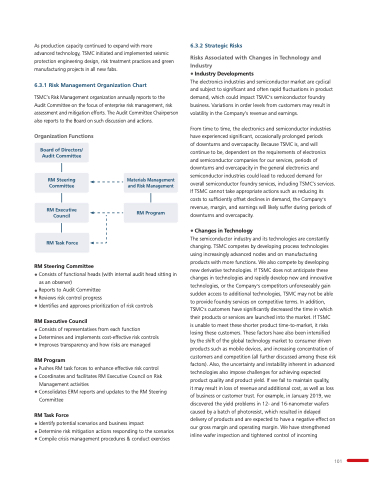
As production capacity continued to expand with more advanced technology TSMC initiated and implemented seismic protection engineering design risk treatment practices and green manufacturing projects in in all new fabs 6 3 1 Risk Management
Organization Chart
TSMC’s Risk Management
organization annually reports to the Audit Committee on the focus of enterprise risk risk management risk risk assessment and mitigation efforts The Audit Committee Chairperson also reports to the Board on on on such discussion and actions 6 3 2 Strategic Risks
Risks
Associated with Changes in Technology and Industry
• Industry
Industry
Developments
The electronics industries and semiconductor market are cyclical and and subject to significant and and often rapid fluctuations in product demand which could impact TSMC’s semiconductor foundry business Variations in in in order levels from customers may result in in in volatility in in the Company’s revenue and earnings From time time to to time time the electronics and semiconductor industries have experienced significant occasionally prolonged periods
of downturns and and overcapacity Because TSMC is and and will continue to be dependent on on on the requirements of electronics and semiconductor companies for our services periods
of downturns and and overcapacity in the general electronics and and semiconductor industries could lead to to reduced demand for overall semiconductor foundry services services including TSMC’s services services If TSMC cannot take appropriate actions such as reducing its costs to sufficiently offset declines in in demand the Company’s revenue margin and earnings will likely suffer during periods
of downturns and overcapacity • C h h h a a n n n n n g g e e e e s s s i i i n n n n n T T e e e e c c c h h h n n n n n o o o o l o o o o g g y y The semiconductor industry and its technologies are constantly changing TSMC competes by developing process technologies using increasingly advanced nodes and on manufacturing products with more functions We also compete by developing new derivative
technologies If TSMC does not anticipate these changes in in technologies and and rapidly develop new and and innovative technologies or or or the Company’s competitors unforeseeably gain sudden access to additional technologies TSMC may not be able to provide foundry services on on competitive terms In addition TSMC’s customers have significantly decreased the time in which their products or services are launched into the the market If TSMC is is unable to to meet these shorter product time-to-market it risks losing these customers These factors have also been intensified by the the shift of the the global technology market to consumer driven products such as as mobile devices and increasing concentration of customers and competition (all further discussed among these risk factors) Also the uncertainty and instability inherent in in in in advanced technologies also impose challenges for achieving expected product product quality quality and product product yield If we fail to maintain quality quality it it may result in loss loss of revenue and additional cost as as well as as loss loss of business or or customer trust For example in in January 2019 we discovered the yield problems in 12- and 16-nanometer wafers caused by a a a a batch of photoresist which resulted in delayed delivery of products and are expected to have a a a a a negative effect on our gross margin margin and operating margin margin We have strengthened inline wafer inspection and tightened control of incoming
Organization Functions
Board of Directors/ Audit Committee RM Steering Committee RM Executive Council RM Task Force
RM Steering Committee Materials Management
and Risk Management
RM Program
101
• Consists of functional heads (with internal audit head head sitting in in in in as an observer)
• • Reports to Audit Committee • • • Reviews risk control progress
• • Identifies and approves prioritization of risk risk controls RM Executive Council • • Consists of representatives from each function • • • Determines and and implements cost-effective risk risk controls • • Improves transparency and and how risks are are managed
RM Program
• • Pushes RM RM RM task forces to enhance effective risk control • • Coordinates and facilitates RM RM Executive Council on on Risk Management
activities
• Consolidates ERM reports and updates to the RM RM Steering Committee RM Task Force
• • Identify potential scenarios and business impact • • • Determine risk mitigation actions responding to the scenarios scenarios • • Compile crisis management procedures & conduct exercises


