


Page 299 - 2017 TSMC Annual Report
P. 299
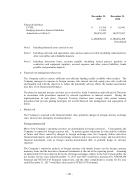
Financial liabilities FVTPL
Hedging derivative financial liabilities Amortized cost (Note 3)
$
18,764
15,562 294,856,247
$
62,441 - 344,572,867
December 31, 2017
December 31, 2016
$ 294,890,573
$ 344,635,308 (Concluded)
Note 1: Note 2:
Note3:
Including financial assets carried at cost.
Including cash and cash equivalents, notes and accounts receivable (including related parties), other receivables and refundable deposits.
Including short-term loans, accounts payable (including related parties), payables to contractors and equipment suppliers, accrued expenses and other current liabilities, bonds payable, and guarantee deposits.
b. Financial risk management objectives
The Company seeks to ensure sufficient cost-efficient funding readily available when needed. The Company manages its exposure to foreign currency risk, interest rate risk, equity price risk, credit risk and liquidity risk with the objective to reduce the potentially adverse effects the market uncertainties may have on its financial performance.
The plans for material treasury activities are reviewed by Audit Committees and/or Board of Directors in accordance with procedures required by relevant regulations or internal controls. During the implementation of such plans, Corporate Treasury function must comply with certain treasury procedures that provide guiding principles for overall financial risk management and segregation of duties.
c. Market risk
The Company is exposed to the financial market risks, primarily changes in foreign currency exchange rates, interest rates and equity investment prices.
Foreign currency risk
Most of the Company’s operating activities are denominated in foreign currencies. Consequently, the
Company is exposed to foreign currency risk. To protect against reductions in value and the volatility of future cash flows caused by changes in foreign exchange rates, the Company utilizes derivative financial instruments, such as forward exchange contracts and cross currency swaps, and non-derivative financial instruments, such as foreign currency-denominated debt, to partially hedge its currency exposure.
The Company’s sensitivity analysis of foreign currency risk mainly focuses on the foreign currency monetary items and the derivatives financial instruments at the end of the reporting period. Assuming an unfavorable 10% movement in the levels of foreign exchanges relative to the New Taiwan dollar, the net income for the years ended December 31, 2017 and 2016 would have decreased by NT$849,248 thousand and NT$116,345 thousand, respectively, and the other comprehensive income for the year ended December 31, 2017 would have decreased by NT$265,875 thousand.
- 151 -
- 151 -


