


Page 258 - 2017 TSMC Annual Report
P. 258
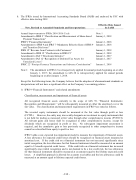
b. The IFRSs issued by International Accounting Standards Board (IASB) and endorsed by FSC with effective date starting 2018
New, Revised or Amended Standards and Interpretations
Annual Improvements to IFRSs 2014-2016 Cycle
Amendment to IFRS 2 “Classification and Measurement of Share-based
Payment Transactions”
IFRS 9 “Financial Instruments”
Amendments to IFRS 9 and IFRS 7 “Mandatory Effective Date of IFRS 9
and Transition Disclosure”
IFRS 15 “Revenue from Contracts with Customers” Amendment to IFRS 15 “Clarifications to IFRS 15” Amendment to IAS 7 “Disclosure Initiative”
Amendment to IAS 12 “Recognition of Deferred Tax Assets for
Unrealized Losses”
IFRIC 22 “Foreign Currency Transactions and Advance Consideration”
Effective Date Issued by IASB
Note 1
January 1, 2018
January 1, 2018 January 1, 2018
January 1, 2018 January 1, 2018 January 1, 2017 January 1, 2017
January 1, 2018
Note 1: The amendment to IFRS 12 is retrospectively applied for annual periods beginning on or after January 1, 2017; the amendment to IAS 28 is retrospectively applied for annual periods beginning on or after January 1, 2018.
Except for the following items, the Company believes that the adoption of aforementioned standards or
interpretations will not have a significant effect on the Company’s accounting policies. 1) IFRS 9 “Financial Instruments” and related amendments
Classification, measurement and impairment of financial assets
All recognized financial assets currently in the scope of IAS 39, “Financial Instruments: Recognition and Measurement,” will be subsequently measured at either the amortized cost or the fair value. The classification and measurement requirements in IFRS 9 are stated as follows.
The invested equity instruments should be measured at the fair value through profit or loss (FVTPL). However, the entity may irrevocably designate an investment in equity instruments that is not held for trading as measured at fair value through other comprehensive income (FVTOCI). All relevant gains and losses shall be recognized in other comprehensive income, except for dividends which are recognized in profit or loss. No subsequent impairment assessment is required, and the cumulative gain or loss previously recognized in other comprehensive income cannot be reclassified from equity to profit or loss.
IFRS 9 adds a new expected loss impairment model to measure the impairment of financial assets. A loss allowance for expected credit losses should be recognized on financial assets measured at amortized cost. If the credit risk on a financial instrument has not increased significantly since initial recognition, the loss allowance for that financial instrument should be measured at an amount equal to 12-month expected credit losses. If the credit risk on a financial instrument has increased significantly since initial recognition and is not deemed to be a low credit risk, the loss allowance for that financial instrument should be measured at an amount equal to the lifetime expected credit losses. A simplified approach is allowed for accounts receivables and the loss allowance could be measured at an amount equal to lifetime expected credit losses.
- 110 -
- 110 -


